



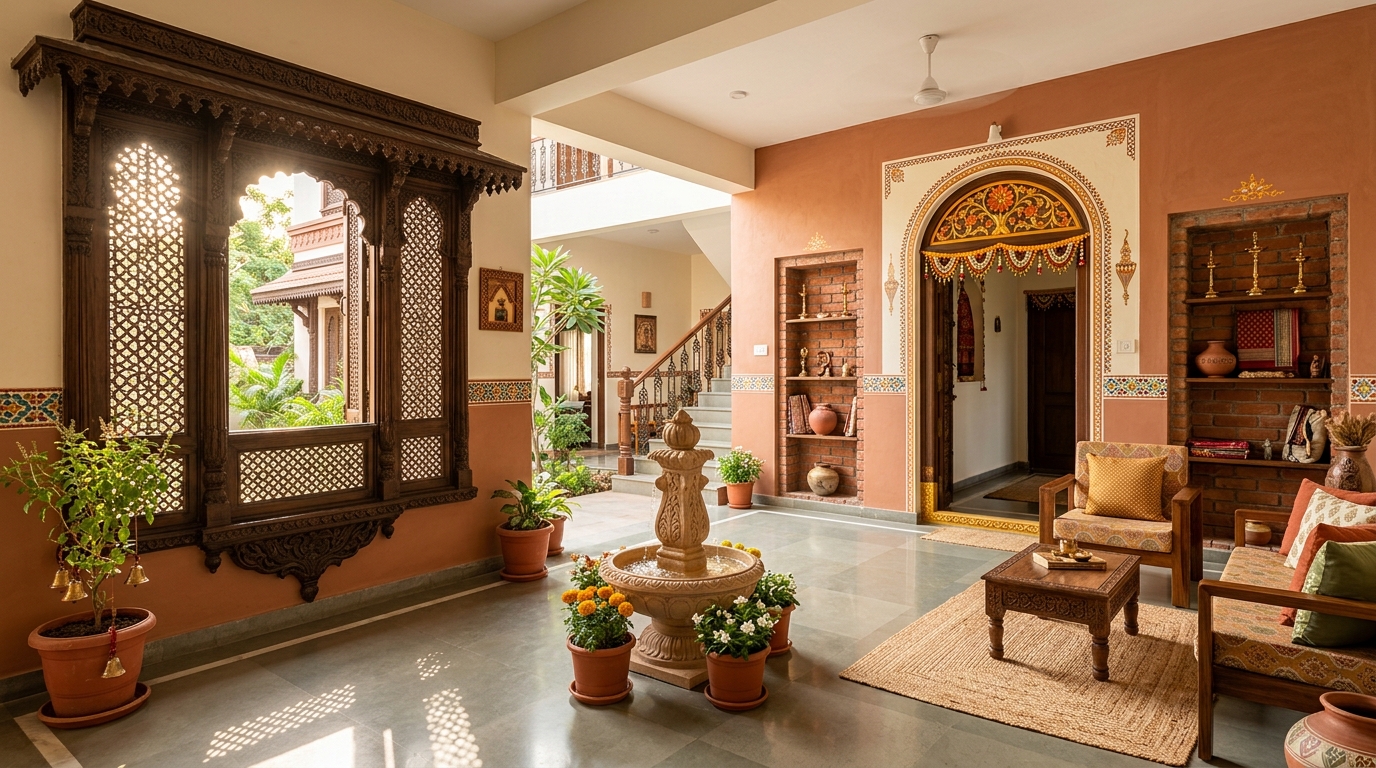
Traditional Gujarati Architecture for Modern Homes in Vadodara 2026
Many homeowners in areas like Fatehgunj and Alkapuri are asking the same question when planning their traditional Gujarati architecture home design in Vadodara: how do you bring the warmth of a heritage haveli into a modern floor plan without it looking like a museum? It is a real design challenge, and one that requires both cultural knowledge and construction expertise. At JKC Buildcon Services, we work with families across Vadodara who want their new home or renovation to carry the soul of Gujarat’s architectural legacy. If you are planning your ghar bandhkam project this year, Book a Free Site Visit to discuss your vision with our experienced team.
2026 Cost Guide: Traditional Gujarati Architecture Elements in Vadodara
Material costs across Gujarat have seen significant inflation since 2022, and heritage-style construction elements are no exception. Carved sandstone, teak woodwork, and hand-painted tiles are specialty items that carry both material and skilled labor premiums. The table below reflects combined material and labor costs as of 2026 for the Vadodara residential market.
| Design Element | Low Budget (INR) | Mid Range (INR) | Premium (INR) |
|---|---|---|---|
| Jharokha Window (per unit) | ₹18,000 – ₹25,000 | ₹35,000 – ₹60,000 | ₹80,000 – ₹1,50,000 |
| Carved Teak Door (per door) | ₹22,000 – ₹35,000 | ₹50,000 – ₹90,000 | ₹1,20,000 – ₹2,50,000 |
| Sandstone Facade Cladding (per sq ft) | ₹180 – ₹280 | ₹320 – ₹500 | ₹600 – ₹950 |
| Courtyard (Chowk) Construction (per sq ft) | ₹1,200 – ₹1,800 | ₹2,200 – ₹3,500 | ₹4,500 – ₹7,000 |
| Traditional Tile Flooring (per sq ft) | ₹90 – ₹150 | ₹180 – ₹320 | ₹400 – ₹700 |
| POP / Plaster Heritage Motif Ceiling (per sq ft) | ₹80 – ₹130 | ₹160 – ₹280 | ₹350 – ₹600 |
| China Mosaic Accent Work (per sq ft) | ₹120 – ₹200 | ₹250 – ₹400 | ₹500 – ₹800 |
Contractor Insight: Budgets for heritage-inspired homes in Vadodara typically run 20–35% higher than standard construction due to specialized labor. Plan your budget with a 15% contingency buffer for custom carved elements.
Key Traditional Gujarati Architecture Elements for Modern Homes
Gujarat’s architectural heritage is one of the richest in India, shaped by centuries of trade, culture, and craftsmanship. Incorporating these elements into a modern home is not about copying the past — it is about translating timeless design principles into contemporary living spaces. Understanding which elements carry the most visual and cultural impact helps you prioritize your makaan renovation budget wisely.
Jharokha Windows and Ornate Facades
The jharokha — a projecting balcony window with ornate carved brackets — is perhaps the single most recognizable element of Gujarati residential architecture. In modern homes, a jharokha can be incorporated as a feature window on the first floor facade, using either authentic carved sandstone or high-quality fiber-reinforced polymer replicas for budget-conscious builds. The visual impact on a street-facing elevation is dramatic and immediate.
Even a single well-executed jharokha on your main facade can define the entire character of your home. Pair it with jaali screens (latticed stone or wood panels) on either side for an authentic layered look. These also serve a functional purpose — they filter harsh Vadodara summer sunlight while maintaining airflow.
- Sandstone jharokha: Authentic, durable, best for permanent installations
- Teak wood jharokha: Warmer tone, requires periodic maintenance in Gujarat’s humid monsoon season
- FRP replica jharokha: Budget-friendly, lighter, easier to install on upper floors
- Jaali panels: Ideal for boundary walls, verandah screens, and staircase railings
Central Courtyard (Chowk) Adaptation
The chowk or central courtyard is the heart of a traditional Gujarati haveli. It creates natural ventilation, brings daylight deep into the home, and serves as the social nucleus of family life. In modern urban plots in Vadodara — which are often narrower than heritage plots — a full courtyard may not be feasible, but a skylight courtyard or internal light well can achieve a similar effect.
A compact 8×8 ft internal courtyard with a glazed roof can transform the feel of a ground-plus-one home. It draws natural light to interior rooms that would otherwise be artificially lit all day. This also helps with passive cooling — a significant advantage given Vadodara’s intense summer temperatures.
- Full open chowk: Best for plots above 2,000 sq ft
- Glazed skylight courtyard: Works well for 1,000–2,000 sq ft urban plots
- Feature atrium with heritage tile flooring: Ideal for narrow plots
- Tulsi courtyard corner: A smaller sacred garden nook that preserves cultural tradition
Traditional Woodwork and Carved Detailing
Gujarati architecture is famous for its intricate woodwork — carved door frames, pillared verandahs, and decorative brackets called kanthis. These elements bring warmth and texture to any home interior or exterior. For a modern home, you do not need to carve every surface — strategic placement of carved elements at the main entrance, puja room, and staircase creates maximum impact.
Teak remains the gold standard for carved woodwork in Gujarat, though Sheesham (Indian Rosewood) offers a more affordable alternative with comparable durability. Work with craftsmen who specialize in traditional Gujarati motifs — geometric patterns, floral vines, and peacock motifs are all culturally rooted and visually timeless.
- Main entrance door with carved teak frame
- Wooden pillar or column at verandah entrance
- Carved wooden ceiling beams in living room
- Puja room with traditional jali-back and carved archway
- Staircase railing with wooden balustrades in traditional pattern
Material Selection Guide for Gujarati-Style Homes
Choosing the right materials is where heritage design projects succeed or fail. The Vadodara climate — hot summers, a genuine monsoon season, and moderate winters — places specific demands on materials used for both exterior and interior heritage elements. Selecting materials that look traditional but perform well in Gujarat’s conditions is essential for long-term satisfaction.
Stone and Sandstone Options
Dhrangadhra sandstone from Surendranagar district is the most historically authentic choice for Gujarati-style facades, jharokhas, and courtyard flooring. It is naturally warm in tone, easy to carve, and has been used in Gujarat’s temples and havelis for centuries. However, it requires sealing to prevent water absorption during monsoon season.
Kota stone is a more durable and affordable option for flooring in courtyards and verandahs. For exterior cladding, Jaisalmer yellow sandstone offers a richer golden tone and excellent weather resistance. Both are widely available through Vadodara’s stone suppliers in the Makarpura and Gorwa industrial areas.
- Dhrangadhra Sandstone: Most authentic, carvable, requires sealing — best for jharokhas and decorative elements
- Kota Stone: Durable, affordable, low maintenance — best for courtyard and verandah floors
- Jaisalmer Yellow Sandstone: Premium look, weather-resistant — best for exterior facade cladding
- Marble (Makrana): Traditional for puja rooms and formal living areas
Traditional Tiles and Flooring
Heritage-style flooring makes an enormous visual impact in a traditional Gujarati home design. Athangudi tiles (hand-painted cement tiles from Tamil Nadu, widely used in heritage renovations across India) are a popular choice for living areas and courtyards. For a more local aesthetic, Mangalore-pattern terracotta tiles work beautifully in verandahs and entrance areas.
China mosaic work — a specialty of JKC Buildcon Services — can be used to create traditional geometric patterns on steps, garden paths, and feature walls. It is durable, low-maintenance, and visually striking. Combine it with traditional tile flooring for a layered, authentic look.
- Athangudi cement tiles: ₹180–₹450 per sq ft installed, ideal for living rooms
- Terracotta tiles: ₹90–₹180 per sq ft installed, ideal for verandahs
- China mosaic: ₹120–₹500 per sq ft installed, ideal for accent features
- Kota stone flooring: ₹100–₹220 per sq ft installed, ideal for courtyards
Vastu and Design Considerations for Traditional Gujarati Homes
Traditional Gujarati architecture and Vastu Shastra are deeply intertwined — the orientation of the main entrance, placement of the kitchen, and positioning of the puja room are all governed by ancient principles that also happen to align with sensible environmental design. Incorporating Vastu into your ghar sudharo project is not superstition — it is a framework that has informed Gujarat’s residential design for over a thousand years.
The main entrance of a traditional Gujarati home ideally faces East or North, allowing morning light to penetrate the home and creating a positive energy flow. The kitchen is typically placed in the Southeast quadrant, and the puja room in the Northeast. These placements, when followed during new construction, rarely conflict with modern floor plan requirements.
- Main entrance (Dwaar): East or North facing, with a raised threshold (dehrli)
- Puja room: Northeast corner, with natural light and good ventilation
- Kitchen: Southeast quadrant, away from the main entrance
- Master bedroom: Southwest corner for stability and rest
- Courtyard: Central or slightly North of center for maximum benefit
- Water features: Northeast or North — avoid Southwest placement
Pro Tip: Even if you are renovating an existing home rather than building new, small adjustments — like adding a dehrli (threshold step) at the main entrance or repositioning a puja alcove — can meaningfully align your space with traditional Gujarati design principles without structural changes.
Color choices in traditional Gujarati homes are also meaningful. Earthy ochres, terracotta reds, deep indigo blues, and lime whites are historically rooted in local pigment traditions. These colors also perform well in Vadodara’s climate — light exterior colors reflect heat, while warm interior tones create a grounded, welcoming atmosphere.
Step-by-Step Process Guide: Integrating Heritage Design into Your Home
Incorporating traditional Gujarati architecture into a new or existing home is a phased process that requires careful planning, skilled craftsmen, and quality material sourcing. Rushing any phase typically results in elements that look artificial rather than authentic. Here is how a well-managed heritage-inspired home project unfolds in Vadodara in 2026.
- Phase 1 – Design Consultation and Reference Collection (Week 1–2): Work with your architect or contractor to identify which heritage elements you want to incorporate. Visit reference sites — Vadodara’s Nazarbaug Palace area, Mandvi ni Pol, and heritage havelis in the old city are excellent local references. Collect visual references and define your style direction.
- Phase 2 – Structural Planning and Permits (Week 3–4): Structural modifications for courtyards, jharokhas, and facade changes may require municipal approvals from the Vadodara Municipal Corporation. Your contractor should handle this documentation. Ensure your structural engineer accounts for the additional load of stone cladding or carved elements.
- Phase 3 – Material Sourcing (Week 4–6): Source sandstone, teak, specialty tiles, and carved elements early — these have longer lead times than standard construction materials. Custom carved pieces from Rajasthan or local Vadodara craftsmen can take 4–8 weeks to produce.
- Phase 4 – Core Construction and Structural Work (Week 6–16): Complete the structural shell, courtyard framing, and facade preparation before installing heritage finishes. This is also when electrical and plumbing rough-in work should be completed.
- Phase 5 – Heritage Finish Installation (Week 16–24): Install carved elements, stone cladding, specialty tiles, woodwork, POP ceiling motifs, and China mosaic work. This phase requires the most skilled craftsmen and the most careful supervision.
- Phase 6 – Painting and Final Finishes (Week 24–28): Apply heritage color palettes using quality exterior and interior paints. Traditional lime-wash techniques can be applied to interior walls for an authentic texture.
Contractor Insight: The biggest timeline delays in heritage-style projects come from late material sourcing. Always order custom carved elements and specialty tiles at least 8 weeks before you need them on site.
Common Mistakes Homeowners Make with Traditional Gujarati Architecture
Heritage-inspired home design is one of the most rewarding construction projects you can undertake — and also one of the easiest to get wrong. After 25+ years of experience with ghar bandhkam projects across Vadodara, the team at JKC Buildcon Services has seen the same four mistakes repeated by well-intentioned homeowners.
Mistake 1: Mixing Too Many Regional Styles
Combining Rajasthani, Mughal, South Indian, and Gujarati elements in a single home creates visual chaos rather than cultural richness. Each tradition has its own vocabulary of motifs, proportions, and color. Choose one primary regional style and use others only as very subtle accents. A Gujarati home should feel distinctly Gujarati — not a pan-Indian theme park.
Mistake 2: Using Low-Quality Replicas for Key Focal Points
Saving money on the main entrance door or the primary jharokha by using cheap fiber replicas is a false economy. These are the first things every visitor sees, and poor-quality replicas look exactly like what they are. Invest in authentic materials for the 3–4 key focal points of your home and economize elsewhere.
Mistake 3: Ignoring Climate Performance
Traditional materials chosen purely for aesthetics without considering Vadodara’s climate will fail within a few monsoon seasons. Unsealed sandstone absorbs moisture, carved teak without proper treatment warps, and certain heritage tiles crack under thermal expansion. Always specify materials with appropriate treatments and sealants for Gujarat’s climate.
Mistake 4: Hiring General Contractors Without Heritage Experience
Traditional Gujarati architectural elements require craftsmen who understand the specific techniques — stone carving proportions, jaali geometry, teak joinery methods. A general contractor who has never executed these elements will produce results that look clumsy and inauthentic. Always verify a contractor’s portfolio of heritage-style projects before signing any agreement.
- Ask to see at least 3 completed heritage-style projects in Vadodara
- Visit at least one completed project in person if possible
- Confirm that the contractor has access to skilled carvers and stone workers
- Get material specifications in writing — not just verbal promises
How to Choose the Right Contractor in Vadodara for Heritage-Style Construction
Choosing the right construction partner for a traditional Gujarati architecture home design project in Vadodara is arguably the most important decision you will make. This is a specialized area of construction, and the difference between an experienced team and a general contractor is visible in every detail of the finished home. Here are five practical criteria to use when vetting contractors.
- Verified Portfolio of Heritage Projects: Ask specifically for photos and client references from homes with traditional Gujarati elements — jharokhas, carved doors, stone facades, or courtyard construction. A contractor who has only done standard residential builds will struggle with heritage detailing.
- Access to Skilled Specialist Craftsmen: Heritage construction requires stone carvers, teak woodworkers, and tile mosaic specialists. Ask your contractor directly: do you have these craftsmen on your team or do you subcontract them? Subcontracting specialty work to unknown parties creates quality and accountability gaps.
- Transparent, Itemized Quotation: Heritage projects have many line items — each carved element, each material specification, each finish type. A contractor who gives you a single lump-sum quote without breakdown is a red flag. Insist on a detailed, itemized estimate.
- Knowledge of Local Material Sources: A Vadodara-based contractor should know exactly where to source Dhrangadhra sandstone, Athangudi tiles, quality teak, and other heritage materials. If they seem uncertain about sourcing, their execution will likely be uncertain too.
- Clear Timeline with Milestone Commitments: Heritage projects run longer than standard construction. A good contractor will give you a realistic timeline with defined milestones — not vague promises. Ask for a written project schedule before work begins.
- Post-Completion Support: Heritage materials like carved stone and teak require periodic maintenance. Ask whether the contractor provides guidance on post-completion care and whether they offer any warranty on their workmanship.
The team at JKC Buildcon Services brings over 25 years of construction experience in Vadodara, with a strong portfolio of heritage-influenced residential projects. Our 100% transparent pricing policy means every element — from a carved jharokha to China mosaic work — is clearly specified and priced before work begins. To discuss your traditional Gujarati architecture home design project with our team, schedule your free site visit today.
Frequently Asked Questions
How much does it cost to build a traditional Gujarati-style home in Vadodara in 2026?
The cost depends significantly on which heritage elements you incorporate and at what level of authenticity. A standard new home construction in Vadodara in 2026 runs approximately ₹1,800–₹2,500 per sq ft for mid-range quality. Adding traditional Gujarati elements — carved stone facade, jharokhas, courtyard, and teak woodwork — typically adds 20–40% to the base construction cost, depending on the extent of heritage detailing. A 1,500 sq ft home with moderate heritage elements might cost between ₹35–₹55 lakhs all-inclusive. Premium heritage homes with authentic carved sandstone, teak joinery, and hand-painted tile work can exceed ₹75–₹90 lakhs for the same footprint.
Can traditional Gujarati architectural elements be added to an existing modern home in Vadodara?
Absolutely — and this is actually one of the most common requests in makaan renovation projects across Vadodara. The most impactful additions to an existing home are: replacing the main entrance door with a carved teak or sandstone-framed door, adding a jharokha feature window to the street-facing facade, applying sandstone cladding to the exterior, and incorporating traditional tile flooring in the entrance foyer. These changes do not require major structural work and can dramatically transform the character of an existing home. A phased renovation approach — starting with the facade and entrance — gives you the biggest visual return on your investment.
Where can I find craftsmen who specialize in traditional Gujarati woodwork and stone carving in Vadodara?
Vadodara has a tradition of skilled craftsmen, and several communities in and around the city specialize in traditional woodwork and stone carving. The areas around Sayajigunj and the old city pol areas have workshops with hereditary craftsmen who have practiced these skills for generations. Rajasthan — particularly Jaisalmer and Jodhpur — is another major source for carved sandstone elements that can be shipped to Vadodara. The most reliable approach, however, is to work with an experienced local contractor like JKC Buildcon Services who already has established relationships with these craftsmen and can vouch for their quality and reliability.
Is it possible to incorporate a traditional courtyard (chowk) in a modern urban plot in Vadodara?
Yes, though it requires thoughtful design adaptation for smaller urban plots. A full open-air chowk typically needs a plot of at least 1,800–2,000 sq ft to function well without making the surrounding rooms feel cramped. For smaller plots — common in areas like Manjalpur, Gotri, and Waghodia Road — a glazed skylight courtyard or an internal light well achieves the same functional benefits (natural light, ventilation, visual focal point) within a compact footprint. Even a 6×6 ft glazed atrium with heritage tile flooring and a small tulsi planter creates a meaningful connection to traditional Gujarati living culture. Your structural engineer and architect will need to plan for this from the early design stage.
How do I maintain traditional materials like carved sandstone and teak in Vadodara’s climate?
Vadodara’s climate — with intense summer heat, monsoon humidity, and occasional cold winters — requires specific maintenance protocols for heritage materials. Sandstone should be sealed with a penetrating stone sealer every 3–5 years to prevent water absorption and moss growth during monsoon. Teak woodwork should be cleaned and re-oiled with teak oil or treated with a quality exterior wood finish annually — especially elements exposed to direct weather. Traditional cement tiles should be sealed with a matte tile sealer after installation and cleaned with pH-neutral cleaners only. China mosaic is the lowest maintenance heritage finish — it requires only regular cleaning and occasional grout touch-up. Your contractor should provide a written maintenance schedule at project handover.
Conclusion: Build a Home That Carries Gujarat’s Soul Forward
Traditional Gujarati architecture home design in Vadodara is not a nostalgic exercise — it is a thoughtful, deliberate choice to build a home that is rooted in cultural identity, climatically intelligent, and visually extraordinary. The elements that defined Gujarat’s great havelis — the carved jharokhas, the central chowk, the intricate woodwork, the warm sandstone facades — are as relevant and beautiful today as they were centuries ago. They simply need to be interpreted for modern living with skill and sensitivity.
The key to success is working with a construction partner who understands both the technical demands of heritage materials and the cultural grammar of Gujarati design. With over 25 years of experience in Vadodara’s residential construction market, JKC Buildcon Services has the craftsmen, the material knowledge, and the project management expertise to bring your heritage-inspired vision to life — whether you are building a new home from the ground up or renovating an existing property. Our transparent pricing and on-time delivery commitment mean you will never face unwelcome surprises during your project.
If you are ready to explore how traditional Gujarati architecture can be woven into your new home or floor extension project in Vadodara, we would love to walk through your site and share our ideas. get a free on-site consultation with our team and take the first step toward building a home that truly reflects who you are and where you come from.