



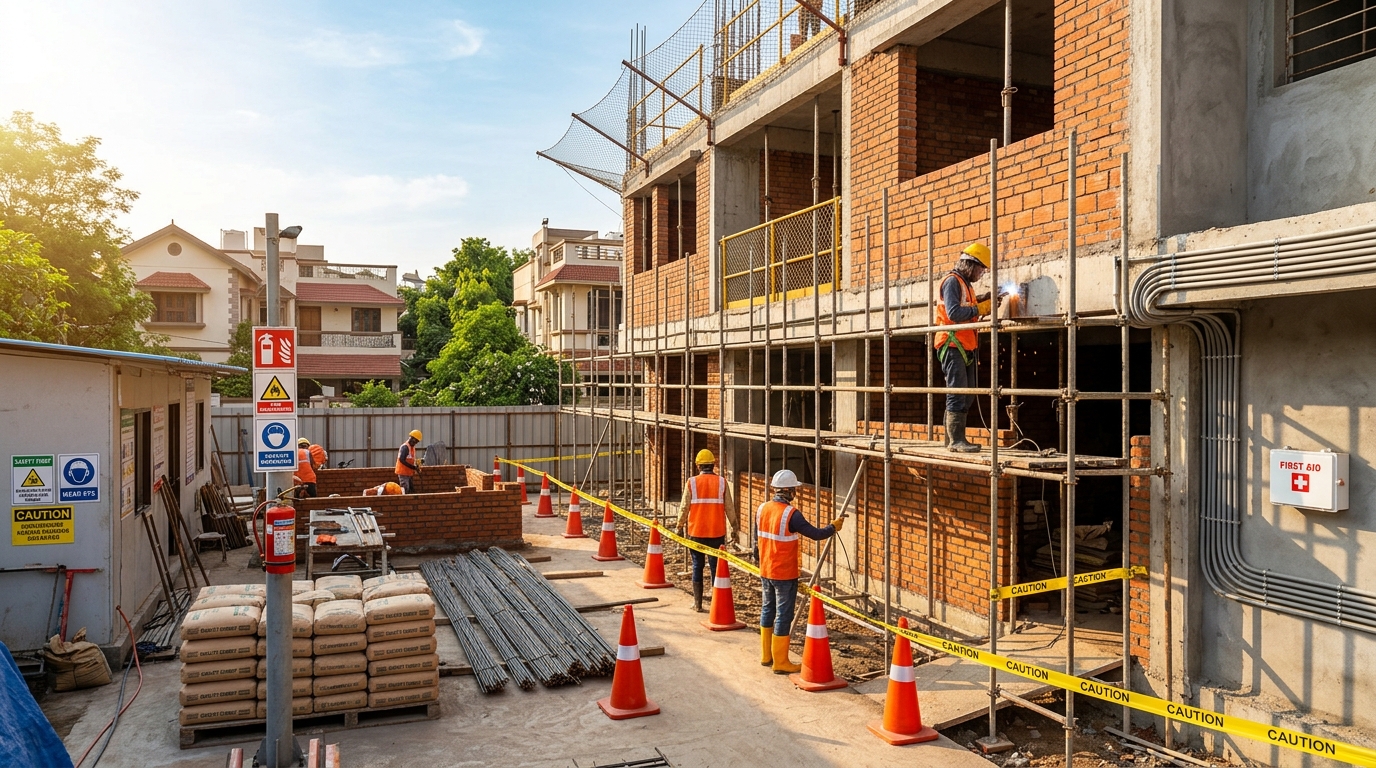
Construction Safety Standards Every Vadodara Homeowner Must Know 2026
Every week in areas like Alkapuri, Gotri, and Waghodia Road, new residential construction projects kick off — and a surprising number of them skip basic construction safety standards Vadodara regulations require. Whether you are building a new home, adding a floor, or doing a full makaan renovation, ignoring safety protocols puts workers, neighbors, and your own family at serious risk. This guide breaks down exactly what standards apply to your project in 2026, what to demand from your contractor, and how to protect your investment from the ground up. If you are about to start a project, Book a Free Site Visit with our team before work begins.
Table of Contents
- 1. 2026 Safety Compliance Cost Guide for Vadodara Projects
- 2. Permits and Legal Requirements in Vadodara
- 3. Step-by-Step Safety Process Guide: Phase by Phase
- 4. Common Mistakes Homeowners Make with Construction Safety
- 5. Red Flags to Watch Out For in Vadodara Contractors
- 6. How to Choose the Right Contractor in Vadodara
- 7. Frequently Asked Questions
- 8. Conclusion
1. 2026 Safety Compliance Cost Guide for Vadodara Projects
Safety compliance is not free — but it is far cheaper than a site accident, a legal notice from Vadodara Municipal Corporation (VMC), or a structural failure mid-construction. In 2026, material costs in Gujarat have risen 12–18% post-2022, which also affects safety equipment and compliance infrastructure.
Below is a realistic cost breakdown for safety-related expenses on a standard residential construction project in Vadodara. These figures combine both material and labor costs as they apply on-site.
| Safety Compliance Item | Low Tier (Basic) | Mid Tier (Standard) | Premium Tier (Full Compliance) |
|---|---|---|---|
| Site Hoarding / Barricading | ₹8,000 – ₹15,000 | ₹18,000 – ₹28,000 | ₹30,000 – ₹50,000 |
| PPE (Helmets, Gloves, Harness per worker) | ₹500 – ₹800/worker | ₹900 – ₹1,400/worker | ₹1,500 – ₹2,500/worker |
| Scaffolding (Per 100 sq ft) | ₹4,000 – ₹7,000 | ₹8,000 – ₹14,000 | ₹15,000 – ₹25,000 |
| Electrical Safety Setup (Temporary) | ₹3,500 – ₹6,000 | ₹7,000 – ₹12,000 | ₹13,000 – ₹22,000 |
| Fire Extinguisher + First Aid Kit | ₹2,000 – ₹3,500 | ₹4,000 – ₹6,500 | ₹7,000 – ₹12,000 |
| Structural Safety Inspection (Engineer Visit) | ₹3,000 – ₹5,000 | ₹6,000 – ₹10,000 | ₹12,000 – ₹20,000 |
| Estimated Total per Project | ₹25,000 – ₹45,000 | ₹50,000 – ₹85,000 | ₹90,000 – ₹1,60,000 |
Pro Tip: Never treat safety compliance as a cost-cutting area. A single site accident can result in legal liability, project delays of 4–8 weeks, and compensation claims that far exceed the cost of proper safety setup.
2. Permits and Legal Requirements in Vadodara
In 2026, Vadodara Municipal Corporation (VMC) enforces strict construction regulations under the Gujarat Development Control Regulations (GDCR). Any ghar bandhkam project above a certain floor area requires a valid building permit before a single brick is laid. Skipping this step can result in demolition orders, heavy fines, or an inability to sell the property later.
The National Building Code (NBC) 2016 is the primary safety standard that all contractors in Vadodara must follow. It covers structural integrity, fire safety, electrical systems, and worker safety protocols. Your contractor must be familiar with NBC provisions as they apply to residential and commercial construction in Gujarat.
Key Permits and Approvals Required in Vadodara (2026)
- Building Permission from VMC — mandatory for new construction and floor extensions above ground floor
- Environmental Clearance — required for projects above 20,000 sq ft built-up area
- Fire NOC — compulsory for buildings above 15 meters height or commercial mixed-use structures
- Structural Stability Certificate — issued by a licensed structural engineer, required before occupancy
- Labour Registration — contractors must register workers under the Building and Other Construction Workers Act
- Commencement Certificate — issued after plan approval, must be displayed at site
On-Site Legal Safety Obligations
Under the Factories Act and BOCW Act, any construction site employing 10 or more workers must maintain a first aid box, appoint a safety officer, and display emergency contact numbers prominently. VMC inspectors can visit your site unannounced, and violations result in stop-work orders. Ensure your contractor provides you with copies of all permits before work begins.
Contractor Insight: At JKC Buildcon Services, every project begins with a permit verification checklist. Homeowners are often unaware that even a bathroom remodeling project that involves structural wall removal requires prior VMC intimation in certain zones of Vadodara.
3. Step-by-Step Safety Process Guide: Phase by Phase
Construction safety is not a one-time checkbox — it must be enforced at every phase of the project. From site preparation to final handover, each stage has its own set of safety requirements. A structured, phase-wise approach is what separates professional contractors from those who cut corners.
Phase 1: Site Preparation and Mobilization
- Erect site hoarding along all boundaries to prevent unauthorized access
- Set up a temporary site office with first aid kit, fire extinguisher, and emergency contacts
- Conduct a soil and foundation assessment by a licensed geotechnical engineer
- Identify and mark underground utilities (water lines, electrical cables) before excavation
- Distribute PPE (Personal Protective Equipment) to all workers before day one
Phase 2: Foundation and Structural Work
During excavation and foundation laying, the risk of soil collapse is highest. Proper shoring and bracing must be installed for any excavation deeper than 1.5 meters. Workers must never enter an unshored trench, and this is a non-negotiable safety rule under NBC 2016.
- Inspect reinforcement bars (rebar) for correct grade and spacing before concrete pour
- Use IS-certified cement and aggregate — do not substitute with substandard materials
- Conduct cube tests for concrete at 7-day and 28-day intervals to verify structural strength
Phase 3: Superstructure and Height Work
Once construction goes above ground level, fall prevention becomes the top priority. All workers operating above 2 meters must wear safety harnesses anchored to certified anchor points. Scaffolding must be inspected every morning before work begins, especially after rain — a common hazard during Vadodara’s monsoon season.
Phase 4: MEP (Mechanical, Electrical, Plumbing) Installation
- All temporary electrical connections must use ELCB (Earth Leakage Circuit Breaker) protection
- Plumbing work must be pressure-tested before walls are closed — leaks inside walls cause long-term structural damage
- Gas line installation must be done only by a licensed gas contractor with VMC approval
Phase 5: Finishing and Handover
During tile work, painting, POP false ceiling, and China mosaic installation, chemical exposure risks increase. Workers must use dust masks, eye protection, and chemical-resistant gloves. Adequate ventilation must be maintained in enclosed spaces during painting and waterproofing work.
Pro Tip: Request a site safety audit report from your contractor at the end of each phase. This document protects both the homeowner and the contractor in case of any future dispute or insurance claim.
4. Common Mistakes Homeowners Make with Construction Safety
Most safety failures on residential construction sites in Vadodara are not caused by ignorance — they are caused by cost-cutting decisions that homeowners make under budget pressure. Understanding the four most common mistakes helps you avoid them before they become expensive problems.
Mistake 1: Allowing Work to Start Without Permits
Many homeowners allow contractors to begin ghar sudharo or new construction work before permits are approved, to “save time.” VMC can issue a stop-work notice at any stage, which freezes your project for weeks or months. In 2026, VMC has intensified enforcement in new development zones like Waghodia Road, Karelibaug, and New Sama Road.
Mistake 2: Not Verifying Contractor Insurance
If a worker is injured on your site and the contractor has no workmen’s compensation insurance, the legal liability can fall on you as the property owner. Always ask for a copy of the contractor’s insurance certificate before signing any agreement. This is a non-negotiable document, not an optional formality.
Mistake 3: Skipping Structural Engineer Verification
For floor extensions Vadodara projects, homeowners often assume the existing structure can bear additional load without independent verification. A licensed structural engineer must assess the existing columns, beams, and foundation before any floor addition begins. Skipping this step has caused partial collapses in several cases across Gujarat in recent years.
Mistake 4: Ignoring Monsoon Safety Protocols
- Fresh concrete poured just before heavy rain loses strength — work must be paused or covered
- Scaffolding stability must be re-verified after every major rain event
- Open excavations must be covered and pumped out before workers re-enter
- Electrical connections must be waterproofed and elevated above ground level during monsoon
Contractor Insight: Vadodara’s monsoon season (June–September) is the highest-risk period for construction sites. Experienced contractors like JKC Buildcon Services build monsoon safety protocols into the project timeline rather than treating them as an afterthought.
5. Red Flags to Watch Out For in Vadodara Contractors
Not every contractor operating in Vadodara follows proper safety standards. Knowing the warning signs of unsafe or unqualified contractors can save you from a project disaster. These red flags apply whether you are doing a small bathroom remodeling project or a full new home construction.
Warning Signs of an Unsafe Contractor
- No PPE on site — workers operating without helmets, gloves, or footwear is an immediate red flag
- Cannot produce permits — any contractor who says “we don’t need permission for this” should be questioned immediately
- No written contract — verbal agreements leave homeowners with zero legal protection if safety violations occur
- Extremely low quotes — prices significantly below market rate usually mean substandard materials or uninsured labor
- No structural engineer involvement — for any load-bearing work, a structural engineer is mandatory, not optional
- Dismissive of safety questions — a professional contractor welcomes safety questions; an unsafe one deflects them
Material-Related Red Flags
Substandard materials are a hidden safety risk that homeowners often cannot detect visually. Insist on IS-certified materials for all structural components — cement, steel, bricks, and electrical wiring. Ask your contractor for material test certificates and purchase receipts, especially for steel reinforcement bars.
- Cement bags without ISI mark should be rejected immediately
- Steel that does not have Fe500 or Fe550 grade marking is not suitable for structural use
- Electrical wiring below IS 694 standard is a fire hazard in finished homes
Pro Tip: Ask your contractor to share material delivery challans and batch numbers. Legitimate contractors maintain these records; those cutting corners cannot produce them.
6. How to Choose the Right Contractor in Vadodara
Choosing a contractor who genuinely follows construction safety standards Vadodara regulations require is as important as choosing one with good design skills. In 2026, with Vadodara’s construction market growing rapidly due to Smart City developments and new township projects, the number of contractors has increased — but quality and compliance vary widely.
5 Practical Criteria to Vet a Contractor
- Verify Registration and Licenses: Check if the contractor is registered with VMC and holds a valid contractor license. Ask for their GSTIN and PAN — legitimate contractors have these readily available.
- Ask for Completed Project References: Request contact details of at least 3 homeowners in Vadodara whose projects they have completed. Visit those sites if possible to verify quality and safety practices firsthand.
- Review the Written Contract in Detail: A proper contract must specify materials with IS grades, payment milestones, safety obligations, penalty clauses for delays, and a defect liability period of minimum 12 months.
- Confirm Insurance Coverage: Ask for a copy of their workmen’s compensation insurance and contractor all-risk (CAR) insurance policy. Verify that the policy is active and covers your project duration.
- Evaluate Safety Setup on Day One: A contractor’s commitment to safety is visible from the very first day of site mobilization. If hoarding, PPE, and a first aid kit are not present before work begins, that tells you everything.
- Transparency in Pricing: Contractors who provide itemized quotations with material specifications and labor rates separately are more accountable than those who give lump-sum quotes with no breakdown.
JKC Buildcon Services has been serving Vadodara homeowners for 25+ years with 100% transparent pricing, documented safety protocols, and a dedicated site supervisor on every project. To evaluate your project requirements before committing, schedule your free site visit with our team today.
Contractor Insight: The cheapest contractor quote in Vadodara typically excludes safety compliance costs, insurance, and proper material grades. When you add these back in, the “cheap” option often becomes the most expensive one.
7. Frequently Asked Questions
Q1: What is the penalty for construction without permission in Vadodara in 2026?
Under VMC regulations and the Gujarat Development Control Regulations (GDCR), unauthorized construction can attract fines ranging from ₹10,000 to ₹5,00,000 depending on the extent of the violation. In serious cases, VMC can issue a demolition order for the unauthorized structure. Additionally, you will not be able to obtain an occupancy certificate, which means the property cannot be legally sold, rented, or mortgaged. In 2026, VMC has increased enforcement activity across Vadodara’s fast-growing zones including Waghodia Road, Sama, and Gotri.
Q2: Is a structural engineer mandatory for a floor extension in Vadodara?
Yes, absolutely. Any floor extension Vadodara project that adds load to an existing structure legally requires a structural stability certificate from a licensed structural engineer. The existing foundation, columns, and beams must be assessed to confirm they can bear the additional load. VMC will not grant a building permission for an additional floor without this certificate. Skipping this step is one of the most dangerous decisions a homeowner can make, as it can compromise the entire building’s integrity.
Q3: What PPE (Personal Protective Equipment) should workers on my site be using?
Under the National Building Code 2016 and BOCW Act, workers must be provided with helmets, safety footwear, high-visibility vests, gloves, and safety harnesses for work above 2 meters height. For specialized work like welding, grinding, or chemical application, additional protection including eye shields, face masks, and chemical-resistant gloves is mandatory. As a homeowner, you have the right to stop work and report to your contractor if you observe workers operating without proper PPE. Responsible contractors like JKC Buildcon Services enforce PPE compliance as a standard site rule, not an optional guideline.
Q4: How do I verify if the cement and steel being used on my site is genuine and IS-certified?
Every cement bag must display the ISI mark (IS 8112 or IS 1489) along with the manufacturer’s name, grade, and date of manufacture. For steel reinforcement bars, check for Fe500 or Fe550 grade markings rolled directly onto the bar — these are not printed labels but physical markings on the metal. Ask your contractor to share material purchase invoices and delivery challans, which will confirm the source and grade. You can also request independent lab testing of concrete cube samples at 7 and 28 days to verify structural strength meets design specifications.
Q5: What safety measures are specifically important during Vadodara’s monsoon season?
Vadodara receives significant rainfall between June and September, which creates unique construction hazards. Fresh concrete must be protected from rain for a minimum of 24–48 hours after pouring to prevent strength loss. Open excavations must be dewatered and inspected before workers re-enter after heavy rain. Scaffolding connections must be checked for loosening after each major rain event. Temporary electrical connections must be elevated and waterproofed, and all workers must be provided with non-slip footwear during wet conditions. Experienced contractors build these monsoon protocols into their project schedules and do not treat them as disruptions.
8. Conclusion: Build Safe, Build Right in Vadodara
Construction safety is not a bureaucratic formality — it is what stands between a successful project and a catastrophic one. Whether you are planning a new ghar bandhkam, a makaan renovation, a bathroom remodeling, or a floor extension in Vadodara, the safety standards covered in this guide are your baseline, not your ceiling. From VMC permits to PPE compliance, from structural engineer verification to monsoon-specific protocols, every element plays a role in protecting your workers, your family, and your investment.
JKC Buildcon Services, co-founded by Kantibhai R C and Chintan K C, has been building and renovating homes across Vadodara for over 25 years with a consistent commitment to transparent pricing, certified materials, and documented safety practices on every site. Our team does not treat safety compliance as an add-on — it is built into every project from day one.
If you are planning a construction or renovation project in 2026 and want to ensure it is done safely, legally, and to the highest quality standards, get a free on-site consultation from our experienced team today. We will assess your site, walk you through all applicable safety requirements, and give you a transparent plan that protects your home and everyone who works on it.