



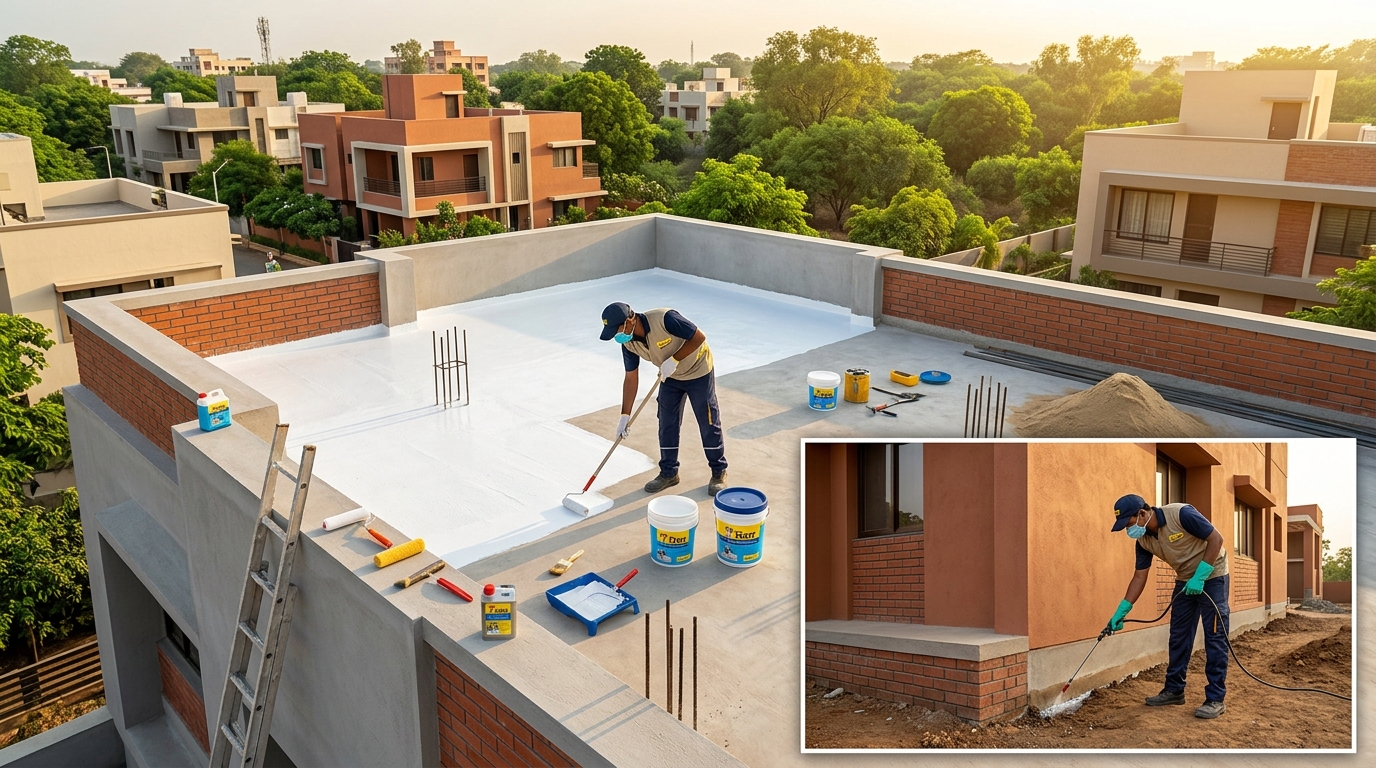
Best Waterproofing & Termite Protection Practices in Vadodara 2026
Every monsoon season, homeowners in areas like Gorwa, Manjalpur, and Waghodia Road in Vadodara call us with the same complaints — seepage through terrace slabs, damp walls in the ground floor, and wooden door frames hollowed out by termites. These are not cosmetic problems. They are structural threats that quietly escalate into lakhs of rupees in repair costs. If you are planning waterproofing and termite protection in Vadodara for your home or commercial property, understanding the right practices before work begins can save you enormous trouble. Book a Free Site Visit with our team to assess your property’s current vulnerability before the next monsoon hits.
Table of Contents
- 1. Waterproofing & Termite Protection Cost Guide for Vadodara 2026
- 2. Material Selection Guide for Vadodara’s Climate
- 3. Step-by-Step Process Guide for Waterproofing & Termite Treatment
- 4. Common Mistakes Homeowners Make
- 5. Maintenance Guide After Waterproofing & Termite Treatment
- 6. How to Choose the Right Contractor in Vadodara
- 7. Frequently Asked Questions
- 8. Conclusion
1. Waterproofing & Termite Protection Cost Guide for Vadodara 2026
Material costs in Gujarat have seen 12–18% inflation post-2022, and that directly impacts what you pay for waterproofing and anti-termite work today. The pricing below reflects the current Vadodara market as of 2026, including both material and labour costs combined. These are realistic ranges — not showroom quotes.
The cost varies significantly depending on the area to be treated, the method chosen, and the severity of existing damage. A terrace waterproofing job for a 1,000 sq ft roof will cost very differently from a full-building anti-termite treatment for a G+2 structure in Subhanpura or Akota.
| Service Type | Low Tier (Budget) | Mid Tier (Standard) | Premium Tier |
|---|---|---|---|
| Terrace / Roof Waterproofing (per sq ft) | ₹35 – ₹55 | ₹60 – ₹90 | ₹100 – ₹150 |
| Bathroom / Wet Area Waterproofing (per sq ft) | ₹45 – ₹70 | ₹80 – ₹110 | ₹120 – ₹180 |
| Basement / Underground Waterproofing (per sq ft) | ₹55 – ₹80 | ₹90 – ₹130 | ₹140 – ₹200 |
| External Wall Waterproofing (per sq ft) | ₹30 – ₹50 | ₹55 – ₹80 | ₹90 – ₹140 |
| Pre-Construction Anti-Termite Treatment (per sq ft) | ₹4 – ₹7 | ₹8 – ₹12 | ₹13 – ₹20 |
| Post-Construction Anti-Termite Treatment (per sq ft) | ₹6 – ₹10 | ₹11 – ₹16 | ₹18 – ₹28 |
| Full Home Anti-Termite + Waterproofing Package (1000 sq ft) | ₹40,000 – ₹65,000 | ₹70,000 – ₹1,10,000 | ₹1,20,000 – ₹2,00,000+ |
Contractor Insight: Never judge waterproofing work by the lowest quote alone. A ₹35/sq ft terrace job using thin bitumen coat without primer will fail within one monsoon. The cost of redoing it — plus interior repair — will be 3x the savings you thought you made.
2. Material Selection Guide for Vadodara’s Climate
Vadodara’s climate is hot and semi-arid with intense monsoon periods — typically June through September — followed by dry, scorching summers. This thermal cycling puts extreme stress on waterproofing membranes and makes subsoil termite activity particularly aggressive. Choosing the right material for this specific climate is not optional — it is foundational.
The construction market in Vadodara now offers a wide range of waterproofing and anti-termite products, from basic cement-based coatings to advanced polyurethane (PU) membranes and crystalline waterproofing systems. Not all of them perform equally in Gujarat’s conditions.
Top Waterproofing Materials for Vadodara Homes
- Dr. Fixit (Pidilite): Most widely used brand in Vadodara. Products like Dr. Fixit Roofseal and Dr. Fixit Pidifin 2K offer excellent UV resistance — critical for terrace applications.
- STP Ltd. Bituthene: Ideal for basement and underground waterproofing where hydrostatic pressure is a concern.
- BASF MasterSeal: Premium crystalline waterproofing used in high-value residential and commercial projects.
- Fosroc Nitoproof: Reliable for external wall and podium waterproofing in mid-to-premium tier projects.
- Asian Paints SmartCare: Budget-friendly option for internal bathroom waterproofing in ghar sudharo renovation projects.
Anti-Termite Treatment Products
- Chlorpyrifos-based soil treatment (e.g., Dursban): Standard pre-construction soil treatment, effective for 5–7 years.
- Imidacloprid-based treatment (e.g., Premise by Bayer): Premium option with 10+ year effectiveness, used for post-construction treatment in finished homes.
- Bifenthrin-based solutions: Widely used in Vadodara for both pre and post-construction stages due to availability and cost balance.
- Termite bait stations: Recommended for properties near gardens or large trees — common in bungalow layouts in Alkapuri and Harni areas.
Pro Tip: In Vadodara’s black cotton soil zones — particularly around Waghodia Road and Padra Road — soil movement during monsoon can break anti-termite chemical barriers. Ask your contractor specifically whether their treatment accounts for expansive soil conditions.
3. Step-by-Step Process Guide for Waterproofing & Termite Treatment
Many homeowners in Vadodara assume waterproofing is simply “applying a coat of something on the roof.” The reality is a multi-stage process that, when done correctly, creates a complete moisture barrier and chemical defence system for your structure. Skipping any phase compromises the entire system.
At JKC Buildcon Services, every waterproofing and anti-termite project follows a defined process — not improvised on site. This is what separates a treatment that lasts 10+ years from one that fails in 18 months.
Phase 1: Site Inspection and Assessment
- Identify existing leakage points, cracks, and seepage zones through visual and moisture meter inspection.
- Check for active termite colonies using probing rods and thermal imaging where needed.
- Assess soil type and drainage patterns around the foundation.
- Document all findings and prepare a treatment plan with material specifications.
Phase 2: Surface Preparation
- Remove all loose plaster, paint, and debris from surfaces to be waterproofed.
- Fill all cracks and honeycombing with polymer-modified mortar or epoxy grout.
- Clean the surface thoroughly — dust and oil contamination cause membrane adhesion failure.
- Allow surfaces to dry to the required moisture content before applying any membrane.
Phase 3: Waterproofing Application
- Apply primer coat as per manufacturer specification (often skipped by low-cost contractors — a critical mistake).
- Apply the waterproofing membrane in two or more coats, with proper curing time between coats.
- Pay special attention to junctions, parapet walls, drain outlets, and pipe penetrations — these are the most common failure points.
- For terraces, apply a screed or protection layer over the membrane before final flooring.
Phase 4: Anti-Termite Treatment Application
- Pre-construction: Treat soil at foundation level, plinth filling, and around column bases before concrete is poured.
- Post-construction: Drill holes at regular intervals along the plinth, inject chemical under pressure, seal with cement slurry.
- Treat wooden fixtures, door frames, and window frames with surface spray or injection treatment.
- Apply a continuous chemical barrier around the perimeter of the building at soil level.
Phase 5: Testing and Handover
- Conduct flood/ponding test on treated terrace for 24–48 hours to verify zero leakage.
- Inspect all treated termite zones for proper sealing and chemical saturation.
- Issue treatment certificate with warranty terms and re-treatment schedule.
4. Common Mistakes Homeowners Make
In our 25+ years of working on ghar bandhkam and renovation projects across Vadodara, we have seen the same costly errors repeated by well-meaning homeowners. These mistakes do not just waste money — they create conditions where waterproofing fails faster than untreated surfaces, and termites spread further than before treatment.
Mistake 1: Treating Waterproofing as a One-Time Cosmetic Fix
Waterproofing is a protective system, not a paint job. Homeowners who apply a single coat of waterproofing paint over an already-damp wall are sealing moisture inside — which accelerates concrete carbonation and rebar corrosion. The correct approach is to identify the water source, treat the root cause, and then apply the membrane system.
Mistake 2: Hiring Unlicensed Applicators for Anti-Termite Chemicals
Anti-termite chemicals in India are regulated pesticides. Application must be done by licensed pest control operators using approved chemicals at specified concentrations. Many homeowners in Vadodara hire daily-wage workers who apply diluted or incorrect chemicals — resulting in zero protection and potential health hazards. Always ask for the Pest Control Operator License before work begins.
Mistake 3: Skipping Treatment at Critical Junction Points
The most common waterproofing failures occur at parapet-to-terrace junctions, pipe penetrations, and expansion joints — not on flat open surfaces. These areas require special treatment with flexible sealants and fabric reinforcement. Contractors who skip these details to save time leave your home’s most vulnerable points completely exposed.
Mistake 4: Not Budgeting for Both Waterproofing and Termite Treatment Together
Many homeowners in Vadodara budget for one or the other — not both. This is a false economy. Termites thrive in moist wood and soil, meaning a home with waterproofing failures is at dramatically higher risk of termite infestation. Treating both together during a makaan renovation or new construction is always more cost-effective than addressing them separately after damage has occurred.
Pro Tip: During any floor extension or addition to your home, always include pre-construction anti-termite soil treatment in the new section — even if the existing structure is already treated. The new soil disturbance creates fresh entry points for termites.
5. Maintenance Guide After Waterproofing & Termite Treatment
A properly done waterproofing and anti-termite treatment is not a lifetime guarantee without maintenance. In Vadodara’s climate — with temperatures hitting 44°C in summer and heavy monsoon rainfall — even the best membranes require periodic inspection and upkeep to maintain effectiveness. Ignoring post-treatment maintenance is the single biggest reason treatments fail before their warranty period ends.
Annual Maintenance Checklist
- Inspect terrace drains and outlets every year before monsoon — blocked drains cause water ponding that stresses the membrane.
- Check parapet wall capping and sealant joints for cracking or separation.
- Inspect all bathroom floors and walls for any tile lifting or grout cracking — early signs of waterproofing failure.
- Look for mud tubes, hollow wood sounds, or discarded wings near door frames — classic termite activity signs.
- Check the chemical barrier zone around the building’s perimeter for any soil disturbance due to digging or construction.
Re-Treatment Schedule
| Treatment Type | Recommended Re-Inspection | Re-Treatment Interval |
|---|---|---|
| Terrace Waterproofing (membrane) | Every 2 years | Every 8–12 years (or as needed) |
| Bathroom Waterproofing | Every 3 years | At time of tile replacement |
| Anti-Termite (Chlorpyrifos) | Every year | Every 5–7 years |
| Anti-Termite (Imidacloprid/Premise) | Every 2 years | Every 10–12 years |
| Bait Station Systems | Every 6 months | Continuous monitoring |
Post-Treatment Care Tips
- Do not drill or nail into treated walls or floors for at least 30 days after waterproofing application to allow full curing.
- Avoid placing heavy planters or water storage directly on treated terrace surfaces — use elevated stands.
- Keep soil around the building’s foundation from piling up against walls — it bridges the anti-termite chemical barrier.
- Ensure bathroom ventilation is adequate — persistent humidity accelerates membrane degradation from inside.
Contractor Insight: We always advise our clients to schedule a free post-monsoon inspection every October. What looks fine in May can show early failure signs after four months of rain — catching it early costs a fraction of full re-treatment.
6. How to Choose the Right Contractor in Vadodara
Waterproofing and termite treatment are technical, chemical-based processes — not general construction work that any mason can handle. In Vadodara’s growing construction market, there is no shortage of contractors who offer these services at low prices but lack the expertise, equipment, or genuine quality materials to deliver lasting results. Here is how to vet your contractor properly before signing anything.
1. Verify Licensing for Anti-Termite Work
Any contractor offering anti-termite treatment must hold a valid Pest Control Operator (PCO) license issued under the Insecticides Act. Ask to see this document before discussions proceed. Unlicensed operators often use counterfeit or diluted chemicals that provide zero protection.
2. Ask for Material Specifications in Writing
A trustworthy contractor will specify the exact brand, product name, and number of coats in the quotation itself — not just “waterproofing material as required.” If a contractor refuses to specify materials, they are likely substituting cheap alternatives on site. Brands like Dr. Fixit, Fosroc, or BASF should be named explicitly.
3. Check Past Projects in Vadodara Specifically
Request references from completed projects in Vadodara — not Ahmedabad or Surat. Local experience matters because soil conditions, drainage patterns, and monsoon behaviour vary significantly across Gujarat. A contractor familiar with Vadodara’s black cotton soil zones will approach foundation treatment differently than one who is not.
4. Insist on a Warranty Certificate
Any professional waterproofing treatment should come with a minimum 5-year written warranty on materials and workmanship. Anti-termite treatments from licensed operators typically carry a 5–10 year warranty depending on the chemical used. Verbal promises are worthless — get it on company letterhead with a stamp.
5. Evaluate Transparency in Pricing
A contractor who gives you a single lump-sum number without breaking down material cost, labour, area coverage, and number of coats is hiding something. At JKC Buildcon Services, every quotation is itemised — clients know exactly what they are paying for before a single rupee is spent. This level of 100% transparent pricing is what you should expect from any reputable contractor.
6. Assess On-Site Professionalism
When the contractor visits for assessment, observe whether they use a moisture meter, probe for termite activity, or simply eyeball the surface and quote immediately. A thorough site assessment is the foundation of accurate treatment — any contractor skipping this step is not equipped to do the job correctly.
Ready to have your property assessed by professionals who follow every one of these standards? schedule your free site visit with our team today — no obligation, no pressure.
7. Frequently Asked Questions
Q1: How much does waterproofing a 1,000 sq ft terrace cost in Vadodara in 2026?
For a standard 1,000 sq ft terrace in Vadodara, you can expect to pay between ₹35,000 and ₹1,50,000 depending on the system chosen. A budget bitumen-based treatment with screed will fall in the ₹35,000–₹55,000 range, while a mid-tier polymer-modified or liquid-applied membrane system will cost ₹60,000–₹90,000. Premium crystalline or PU membrane systems with 10-year warranty will run ₹1,00,000–₹1,50,000 for the same area. These prices include both materials and labour as of 2026 Vadodara market rates, which have absorbed the 12–18% material cost inflation from recent years. Always get a written, itemised quote before committing.
Q2: Is anti-termite treatment necessary before construction in Vadodara?
Yes — and in fact, pre-construction anti-termite soil treatment is mandatory as per IS 6313 (Part 2) for all new buildings in India. Vadodara’s soil composition, particularly in areas near the Vishwamitri river basin and Waghodia Road, has high organic content that supports active termite colonies. Pre-construction treatment is applied to the soil at plinth level and around column bases before concrete is poured — once the structure is built, accessing these zones requires drilling and injection, which is more expensive and less effective. Skipping pre-construction treatment to save ₹4–₹8 per sq ft is one of the most expensive decisions a homeowner can make.
Q3: How long does waterproofing last in Vadodara’s climate?
The lifespan of waterproofing depends heavily on the system used and the quality of application. In Vadodara’s climate — with its extreme UV exposure in summer and intense monsoon rainfall — a properly applied polymer-modified membrane can last 8–12 years, while a basic cement-based coating may need re-treatment in 3–5 years. Premium crystalline waterproofing systems can last the lifetime of the structure if applied correctly. However, all systems require annual inspection, particularly at junction points and drains, to catch early failures before they cause interior damage. Maintenance is not optional — it is part of the treatment lifecycle.
Q4: Can waterproofing and anti-termite treatment be done together during renovation?
Absolutely — and it is the recommended approach. During any makaan renovation or ghar sudharo project, combining waterproofing and anti-termite treatment saves on mobilisation costs, minimises disruption to the household, and ensures both systems are applied with compatible materials. For post-construction anti-termite treatment, the drilling and injection process is best coordinated with any flooring or tile work being done simultaneously — this avoids having to re-open finished surfaces. At JKC Buildcon Services, we routinely combine both treatments as part of comprehensive renovation packages for Vadodara clients, with transparent pricing for the combined scope.
Q5: What are the signs that my home’s waterproofing has failed and needs immediate attention?
The most visible signs of waterproofing failure include yellow or brown stains on ceilings below the terrace, white efflorescence deposits on external walls, paint peeling from interior walls, musty odour in rooms adjacent to bathrooms, and visible cracks in plaster that follow a moisture trail. For termite failure, look for mud tubes along walls or foundation, hollow-sounding wood when tapped, discarded termite wings near windows and door frames, and bubbling or peeling paint with a hollow cavity behind it. Any of these signs in a Vadodara home should be treated as urgent — delaying inspection allows both moisture damage and termite colonies to spread exponentially, compounding repair costs significantly.
8. Conclusion
Waterproofing and termite protection are not luxury add-ons to a home — they are the invisible foundation that determines whether your property holds its value and structural integrity for decades or begins deteriorating quietly from within. In Vadodara’s climate, with its aggressive monsoons, high humidity, and termite-prone soil conditions, these treatments are as essential as the concrete and steel that make up your walls.
The difference between a treatment that lasts 10 years and one that fails in 18 months comes down to three things: the right materials for Vadodara’s specific conditions, a proven step-by-step process executed without shortcuts, and a contractor who stands behind their work with documented warranties. Choosing based on the lowest quote alone is the most expensive decision you can make for your home.
JKC Buildcon Services, with 25+ years of experience in Vadodara’s residential and commercial construction market, brings both the technical expertise and the 100% transparent pricing that homeowners deserve when protecting their most valuable asset. Whether you are building new, renovating an existing home, or dealing with an active leakage or termite problem right now, our team is equipped to assess, plan, and execute the right treatment for your specific situation. get a free on-site consultation today and let us help you protect your home the right way — the first time.