



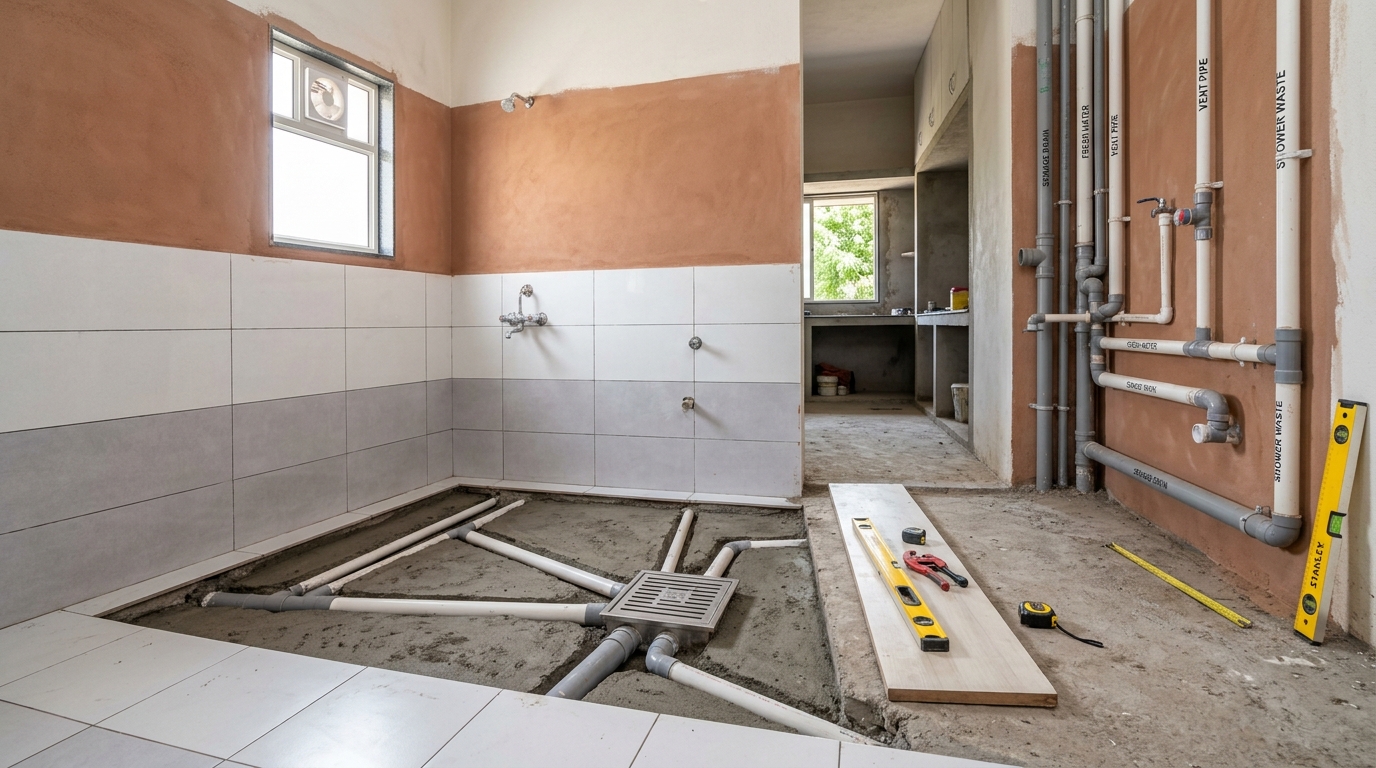
Proper Drainage & Sewage Systems for New Homes in Vadodara 2026
Every monsoon season, homeowners in areas like Gotri, Waghodia Road, and Harni call us with the same problem — waterlogging in the compound, sewage backflow in the bathroom, or drain lines that were never properly sloped during construction. Getting the drainage and sewage system for new house in Vadodara right from day one is not optional — it is the foundation of a healthy, livable home. If you are currently planning ghar bandhkam or a new construction project, this guide will walk you through everything you need to know before a single pipe is laid. Book a Free Site Visit with our team before your foundation work begins.
2026 Cost Guide: Drainage & Sewage Systems in Vadodara
Material costs across Gujarat have risen 12–18% since 2022, and drainage work is no exception. The total cost of installing a complete drainage and sewage system in a new house depends on plot size, number of floors, soil type, and the quality of pipes and fittings selected. Below is a realistic 2026 cost reference for Vadodara homeowners.
| Work Component | Low Budget (₹) | Mid Range (₹) | Premium (₹) |
|---|---|---|---|
| Underground Drainage Lines (per running ft, incl. labour) | ₹120 – ₹160 | ₹180 – ₹240 | ₹280 – ₹360 |
| Sewage Treatment / Septic Tank (1500–2000 litres, incl. labour) | ₹28,000 – ₹40,000 | ₹45,000 – ₹70,000 | ₹80,000 – ₹1,20,000 |
| Rainwater Drainage & Compound Drains (per sq ft, incl. labour) | ₹35 – ₹55 | ₹60 – ₹90 | ₹100 – ₹140 |
| Bathroom & Kitchen Waste Pipe Network (per unit, incl. labour) | ₹8,000 – ₹12,000 | ₹14,000 – ₹22,000 | ₹25,000 – ₹38,000 |
| Inspection Chambers / Manholes (per unit, incl. labour) | ₹4,500 – ₹6,500 | ₹7,000 – ₹11,000 | ₹12,000 – ₹18,000 |
| Complete Drainage System for 1200 sq ft House (all-inclusive) | ₹85,000 – ₹1,20,000 | ₹1,40,000 – ₹2,00,000 | ₹2,20,000 – ₹3,50,000 |
Contractor Insight: Never try to save money on drainage pipe diameter or gradient slope. Undersized pipes and incorrect slope angles are the #1 cause of blockages and sewage backflow in Vadodara homes — repairs after construction cost 3–5x more than getting it right the first time.
These figures reflect the 2026 Gujarat market rates including post-inflation material costs. Prices may vary based on your specific plot location, soil conditions, and access to the VMC sewage line. Always get a detailed, itemised quote before work begins.
Step-by-Step Process: How Drainage & Sewage Is Installed in a New House
A properly designed drainage system is planned at the architectural drawing stage, not after walls are built. The sequence matters enormously — incorrect sequencing leads to costly breakages, re-digging, and structural damage. Here is how a systematic installation looks for a new home in Vadodara.
Phase 1: Site Survey and Drainage Planning
Before any digging, a qualified plumber or civil engineer surveys the plot to determine the natural slope of the land, the location of the VMC (Vadodara Municipal Corporation) sewer connection point, and the soil absorption capacity. This survey determines whether your home needs a septic tank, a soak pit, or a direct VMC connection. Skipping this step is the most expensive mistake a homeowner can make.
- Identify VMC sewer line access point on your street
- Measure natural ground slope for gravity-based drainage
- Check soil type (clay-heavy soil in parts of Vadodara affects soak pits)
- Finalise drainage layout on structural drawings
Phase 2: Underground Drainage Laying (Pre-Slab Stage)
Underground drain pipes are laid before the RCC slab is poured. This is the most critical phase because any error here is buried under concrete. Pipes must be laid at the correct gradient — a minimum slope of 1:80 for soil waste and 1:40 for foul water is standard practice. All joints must be properly sealed and tested before backfilling.
- Trenches dug to required depth (minimum 600mm for main lines)
- Gravel bed laid at trench base for pipe support
- Pipes laid with correct slope using spirit level and string line
- Inspection chambers placed at every change of direction
- Water pressure test conducted before covering
Phase 3: Above-Ground Waste Pipe Network
Once the structure is up, bathroom, kitchen, and balcony waste pipes are installed within walls and chases. Soil stacks (vertical pipes carrying toilet waste) must be vented to the open air above the roof to prevent siphonage and foul odour. Every floor trap and floor drain must have a water seal of at least 50mm depth.
Phase 4: Testing and VMC Connection
Before plastering, a full smoke test or water flow test is conducted across all lines. The final connection to the VMC sewer line requires a formal application and inspection. This step is often delayed when homeowners skip the permit process — plan at least 4–6 weeks for VMC approvals in Vadodara.
Material Selection Guide for Vadodara’s Climate
Vadodara experiences extreme heat (up to 45°C in summers), heavy monsoon rainfall, and high humidity — all of which affect the longevity of drainage materials. Choosing the wrong pipe material leads to cracking, joint failure, and root infiltration within 5–7 years. Here is what works best in this climate.
Pipe Material Comparison
| Material | Best Use | Lifespan | Vadodara Suitability |
|---|---|---|---|
| uPVC (Unplasticised PVC) | Soil stacks, waste lines, underground | 30–50 years | ✅ Excellent — heat resistant, lightweight |
| SWR (Soil, Waste & Rain) PVC | Above-ground drainage, rainwater | 25–35 years | ✅ Very Good — standard for Gujarat homes |
| CI (Cast Iron) | Soil stacks in multi-storey | 50+ years | ⚠️ Good but heavy — used in premium builds |
| RCC Pipes | Deep underground main drains | 40+ years | ✅ Good for large plots and compound drains |
| Ordinary PVC (thin wall) | — | 5–10 years | ❌ Avoid — cracks in Vadodara heat |
Trusted brands available in Vadodara’s building material market include Astral, Supreme, Finolex, and Prince Pipes — all of which offer ISI-marked uPVC and SWR pipes. Always insist on ISI certification and verify the brand embossing on each pipe before accepting delivery.
Pro Tip: In Vadodara’s black cotton soil zones (common near Manjalpur and Karelibaug), pipes expand and contract with seasonal moisture. Use rubber ring jointed pipes underground rather than solvent-welded joints — they absorb ground movement without cracking.
Common Mistakes Homeowners Make with Drainage & Sewage Systems
After 25+ years of construction experience across Vadodara, the team at JKC Buildcon Services has seen the same costly errors repeated on site after site. Most of these mistakes are invisible until the house is occupied — and by then, the repair cost is enormous. Here are the four most damaging ones.
Mistake 1: Designing Drainage After the Structure Is Built
Many homeowners finalise their bathroom positions and kitchen layout after the slab is already cast. This forces plumbers to break the slab to lay drain pipes, weakening the structure and increasing costs by ₹15,000–₹40,000 per floor. Drainage layout must be part of the architectural drawing — not an afterthought.
Mistake 2: Using Incorrect Pipe Slope (Gradient)
A pipe laid too flat will not drain by gravity. A pipe laid too steep causes liquid to run ahead of solids, leaving waste to accumulate and block. The correct gradient is a precise engineering decision — not something to leave to an untrained mason. Many Vadodara homes suffer chronic blockages because of a 1–2 degree error in pipe slope.
Mistake 3: Skipping Inspection Chambers
Homeowners often ask contractors to skip inspection chambers (manholes) to save ₹5,000–₹8,000 per unit. This is a false economy. Without inspection chambers at every junction and change of direction, a single blockage requires excavating the entire drain line. Every turn in an underground drain line needs an accessible chamber.
Mistake 4: Not Separating Grey Water and Black Water Lines
Grey water (from sinks, showers, kitchen) and black water (from toilets) must travel in separate pipe networks until they reach the treatment point. Mixing them in a single line overloads the sewage system and is a VMC compliance violation. Many low-budget contractors combine these lines to save pipe costs — a decision that creates legal and hygiene problems for years.
- Always review the plumbing drawing before construction begins
- Ask your contractor to show pipe slope measurements on site
- Insist on inspection chambers at every directional change
- Confirm grey water and black water are on separate lines
- Get a written pressure test report before plastering walls
Permits and Legal Requirements for Drainage in Vadodara
The Vadodara Municipal Corporation (VMC) has specific rules governing how new homes connect to the public sewer network. Non-compliance can result in fines, forced disconnection, and complications when selling the property. Understanding these requirements before your ghar bandhkam begins saves significant time and money.
VMC Sewer Connection Requirements
Any new residential construction that falls within VMC limits must apply for a formal sewer connection through the VMC’s online portal or the ward office. The application requires your approved building plan, plot details, and a fee that varies by plot size. Unauthorised direct connections to the VMC sewer line carry penalties of ₹10,000–₹50,000.
- Submit sewer connection application with approved building plan
- Pay applicable connection charges (₹3,000–₹15,000 based on plot size in 2026)
- VMC inspection is mandatory before final connection is made
- Properties outside VMC limits (Waghodia Road, Padra outskirts) require a septic tank with soak pit
- Rainwater harvesting pits are now mandatory for plots above 300 sq m under Gujarat building regulations
Environmental Compliance
Gujarat’s GPCB (Gujarat Pollution Control Board) regulations require that no untreated sewage is discharged into open drains, water bodies, or agricultural land. For large plots or commercial-residential projects, a small-scale sewage treatment plant (STP) may be required. Consult a licensed plumbing engineer to determine what applies to your specific project.
Pro Tip: Keep copies of all VMC drainage approvals in a dedicated property file. These documents are required for home loan disbursements, property registration, and future resale — and are surprisingly difficult to obtain retrospectively.
Maintenance Guide: Keeping Your Drainage System Healthy Long-Term
A well-installed drainage system still requires routine maintenance to perform for decades. Vadodara’s hard water, monsoon debris, and heavy cooking habits (which produce significant grease) all accelerate drain deterioration. Building a simple maintenance schedule into your household routine prevents 90% of drainage emergencies.
Monthly Maintenance Tasks
- Pour 1 litre of hot water down all floor traps and rarely-used drains to maintain water seals
- Check all floor drain covers for debris accumulation
- Inspect compound drain outlets for monsoon leaf and mud blockage
- Test all toilet flush mechanisms for proper water volume
Quarterly Maintenance Tasks
- Use a biological drain cleaner (not harsh acid) in kitchen and bathroom drains
- Inspect inspection chamber covers — replace cracked or sunken covers immediately
- Check septic tank level if your property has one (desludge every 2–3 years)
- Inspect roof drainage outlets and downpipes for cracks or joint separation
Annual Professional Check
Once a year, have a qualified plumber conduct a CCTV drain inspection or manual rod-through of your main drain lines. This is especially important in Vadodara homes built on expansive clay soil, where ground movement can shift underground pipes. Early detection of a cracked or displaced pipe costs ₹3,000–₹8,000 to fix — versus ₹40,000+ if the problem is discovered after it causes structural damage.
Contractor Insight: Never use chemical drain cleaners (acid-based) regularly in uPVC pipe systems. Over time, they degrade rubber seals and solvent-welded joints. Enzyme-based biological cleaners are safer and equally effective for routine maintenance.
The team at JKC Buildcon Services recommends that clients who complete a new construction project schedule their first professional drain inspection 12 months after handover, before the monsoon season begins. This one step catches the vast majority of installation issues before they become expensive emergencies.
How to Choose the Right Contractor for Drainage & Sewage Work in Vadodara
Drainage and sewage installation is one of the most technically demanding aspects of makaan renovation or new construction — and unfortunately, one of the most frequently subcontracted to unqualified labour. Choosing the wrong contractor here is a decision you will live with for decades. Use these criteria to vet any contractor before signing an agreement.
1. Ask for a Detailed Drainage Drawing, Not Just a Verbal Plan
A competent contractor will provide a scaled drainage layout drawing showing pipe sizes, slopes, inspection chamber locations, and connection points. If a contractor gives you only a verbal description or a rough sketch, that is a red flag. Proper drainage is an engineering exercise — it requires documentation.
2. Verify Knowledge of VMC Sewer Connection Process
Your contractor must know the current VMC application process, required documents, and inspection timelines. A contractor who is vague about this or says “we will manage it later” is likely planning an unauthorised connection — which becomes your legal problem, not theirs.
3. Check Their Pipe Material Sourcing
Ask specifically which brand and grade of pipe they will use, and request to see the ISI mark and batch number on the pipes delivered to site. Contractors who use unmarked or substandard pipes often quote lower prices — but the cost of replacement within 5–7 years far exceeds the initial saving.
4. Insist on a Written Pressure Test Clause in the Contract
Your contract must include a clause requiring a hydraulic or smoke pressure test of all drain lines before walls are plastered and slabs are covered. Without this, there is no way to verify the system’s integrity until a problem occurs — by which time the pipes are buried under concrete.
5. Ask for References from Completed Projects in Vadodara
Request references from at least 2–3 homeowners in Vadodara whose drainage work was completed by this contractor at least 2 years ago. Ask those homeowners specifically whether they have experienced any blockages, backflow, or odour issues. This is the most reliable quality indicator available.
6. Confirm Post-Handover Support
A reputable contractor offers at least a 1-year workmanship warranty on drainage installation. Any contractor who refuses to put this in writing is not confident in their own work. JKC Buildcon Services provides written warranties on all plumbing and drainage work as standard practice. To get an honest, itemised assessment of your drainage requirements, schedule your free site visit with our team today.
Frequently Asked Questions: Drainage & Sewage Systems for New Homes in Vadodara
Q1. How much does it cost to install a complete drainage system in a new house in Vadodara in 2026?
For a standard 1200 sq ft residential plot in Vadodara, a complete drainage and sewage system including underground lines, bathroom waste networks, inspection chambers, and VMC connection costs between ₹85,000 and ₹3,50,000 depending on the quality tier selected. Mid-range installations with good quality uPVC pipes and proper inspection chambers typically fall in the ₹1,40,000–₹2,00,000 range. This figure includes both materials and labour as per 2026 Gujarat market rates. Always get at least 2–3 itemised quotes before finalising a contractor.
Q2. Do I need a septic tank if my house is in Vadodara city limits?
If your plot falls within the VMC (Vadodara Municipal Corporation) jurisdiction and the street in front has an active VMC sewer line, you are required to connect to the municipal sewer rather than build a septic tank. Septic tanks are typically required for properties on the outskirts — such as Waghodia Road, Padra, Savli, or Shinor areas — where municipal sewer lines are not yet available. Your contractor should verify the sewer line availability through the VMC ward office before designing your drainage system. Building a septic tank where a VMC connection is available and mandatory is a compliance violation.
Q3. How long does drainage installation take for a new house in Vadodara?
The underground drainage phase (pre-slab) typically takes 5–10 working days for a standard 1200–1500 sq ft house, depending on soil conditions and the complexity of the layout. Above-ground waste pipe installation within the structure takes another 7–12 days across all floors. Add 4–6 weeks for VMC sewer connection approval and inspection — this is the most time-consuming part of the process and must be applied for early. Total timeline from design to a tested and connected system is typically 8–12 weeks when properly planned.
Q4. What is the correct pipe size for bathroom drainage in a residential house?
For toilet soil pipes (WC connections), a minimum 100mm (4 inch) diameter uPVC pipe is required. Bathroom floor drains and washbasin waste pipes should use 50mm (2 inch) pipes at minimum. Kitchen waste lines should be a minimum of 75mm (3 inch) to handle grease and food waste loads. The main soil stack (vertical pipe collecting all toilet waste) must be a minimum of 100mm and must be vented above the roof line to prevent siphonage. Using undersized pipes is one of the most common causes of chronic blockages in Vadodara homes.
Q5. Can I add drainage for a floor extension (floor extension Vadodara) to an existing house?
Yes, adding drainage for a floor extension Vadodara project is entirely feasible, but it requires careful planning to tie into the existing drainage stack without overloading it. The existing soil stack capacity must be assessed — a 100mm stack can typically handle up to 4–5 floors of standard residential load. New bathroom and kitchen waste lines on the added floor must connect to the existing stack at proper junctions with appropriate fittings. It is also advisable to inspect the existing underground drain lines before adding load — a CCTV inspection will confirm whether the existing pipes are in good enough condition to handle additional flow from the new floor.
Conclusion: Get Your Drainage Right the First Time
A properly designed and installed drainage and sewage system is invisible when it works — and absolutely impossible to ignore when it fails. Every rupee invested in getting the pipe sizes, slopes, materials, and VMC compliance right during construction saves thousands in repairs, excavation, and structural remediation later. Whether you are building a new home in Gotri, adding a floor in Karelibaug, or undertaking a complete ghar sudharo project, drainage planning must start at the drawing board — not after the slab is poured.
JKC Buildcon Services, co-founded by Kantibhai R C and Chintan K C, has been delivering transparent, quality-first construction and plumbing solutions across Vadodara for over 25 years. Our drainage and sewage installations come with written pressure test documentation, ISI-certified materials, full VMC compliance support, and a 1-year workmanship warranty. We do not cut corners on what you cannot see — because we know that is exactly where the problems start. If you are planning a new home or renovation in Vadodara and want a team that will get your drainage system right from day one, get a free on-site consultation from our experienced team today. No obligations — just honest, expert advice from people who have been building Vadodara homes for a generation.