



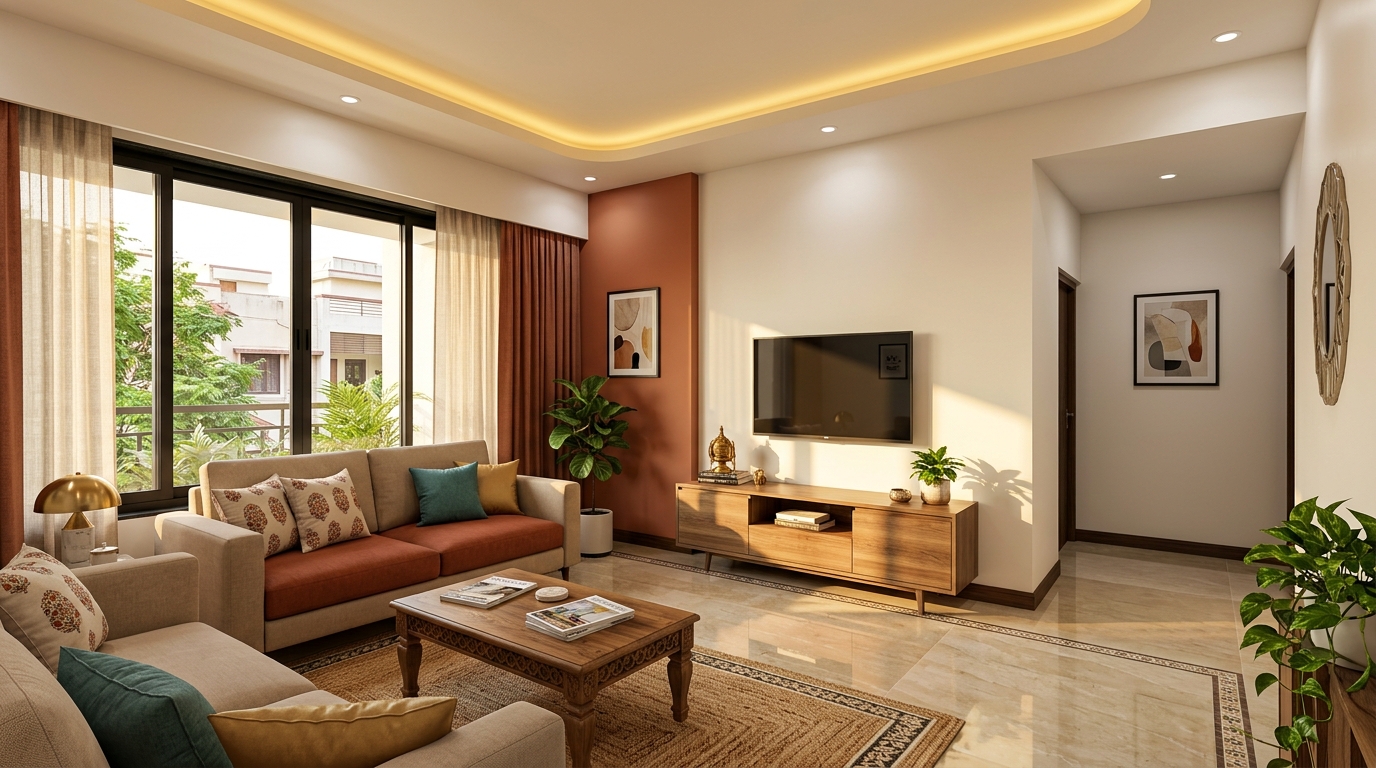
How to Select Interior Design & Finishing Options in Vadodara 2026
Most homeowners in areas like Gotri, Alkapuri, or Akota spend months picking floor tiles and wall colours — only to realise mid-project that their finishing choices don’t align with their budget, Vadodara’s humid summers, or the actual layout of their home. Selecting interior design finishing options Vadodara homeowners can actually live with requires a structured approach, not just Instagram inspiration. At JKC Buildcon Services, we’ve guided hundreds of families through this exact process. If you’re starting fresh or renovating, Book a Free Site Visit before you finalise anything — it saves money and avoids costly rework.
2026 Interior Finishing Cost Guide for Vadodara
Material costs across Gujarat have risen 12–18% since 2022, and 2026 pricing reflects that reality. Whether you’re doing a full ghar sudharo or finishing a new construction, understanding cost tiers upfront prevents budget shocks mid-project. The table below reflects combined material and labour costs for Vadodara’s current market.
| Finishing Category | Low Budget (₹/sq ft) | Mid Range (₹/sq ft) | Premium (₹/sq ft) |
|---|---|---|---|
| Flooring (Tiles / Vitrified) | ₹60 – ₹90 | ₹110 – ₹180 | ₹220 – ₹400+ |
| Wall Painting (Emulsion) | ₹18 – ₹25 | ₹28 – ₹45 | ₹50 – ₹90 |
| POP / False Ceiling | ₹55 – ₹75 | ₹85 – ₹140 | ₹160 – ₹280 |
| Bathroom Tile Work | ₹70 – ₹100 | ₹120 – ₹200 | ₹230 – ₹450+ |
| China Mosaic Work | ₹90 – ₹120 | ₹140 – ₹200 | ₹220 – ₹350+ |
| Texture / Designer Wall Finish | ₹35 – ₹55 | ₹65 – ₹100 | ₹110 – ₹200 |
| Full Interior Fit-Out (per sq ft built-up) | ₹800 – ₹1,200 | ₹1,400 – ₹2,000 | ₹2,200 – ₹4,000+ |
These ranges are Vadodara-specific estimates for 2026 and will vary based on floor area, design complexity, and selected brands. Always get a written, itemised quote before work begins.
Contractor Insight: A mid-range finish for a 1,000 sq ft apartment in Vadodara typically costs between ₹9–₹14 lakh all-in for 2026. Anything quoted significantly below this should raise questions about material quality or hidden charges.
Material Selection Guide for Vadodara’s Climate
Vadodara’s climate — hot summers touching 44°C, moderate humidity, and occasional heavy monsoon — directly impacts which finishing materials perform well long-term. Choosing the wrong material for a ghar bandhkam project here can mean peeling paint, cracked tiles, or warped woodwork within two years. Material selection must factor in thermal expansion, moisture resistance, and dust retention.
Flooring Materials
For living areas, vitrified tiles from brands like Kajaria, Somany, or Asian Granito remain the most practical choice in Vadodara — they handle heat, are easy to clean, and don’t absorb moisture. Marble and granite look premium but require sealing and are cold in winter, which can be uncomfortable in ground-floor rooms. Wooden or laminate flooring is popular in bedrooms but needs good ventilation to avoid warping during monsoon months.
- Best for living rooms: Double-charged vitrified tiles (600×600mm or 800×800mm)
- Best for kitchens: Anti-skid ceramic tiles with matt finish
- Best for bathrooms: Small-format anti-skid tiles or China mosaic
- Best for bedrooms: Laminate wood or large-format vitrified tiles
- Best for balconies: Outdoor-rated anti-skid ceramic or stone finish
Wall Finish Materials
For interior walls, Asian Paints Royale or Berger Silk emulsions offer excellent washability and UV resistance suitable for Vadodara’s conditions. Texture finishes using Birla White or Walplast putty as a base give a premium look at a mid-range cost. Avoid oil-based paints in enclosed rooms — they retain heat and yellow over time in Gujarat’s climate.
- Budget walls: Acrylic emulsion with primer — durable and cost-effective
- Mid-range walls: Texture paint or designer stucco finish
- Premium walls: Venetian plaster, wallpaper with moisture barrier, or 3D panels
Pro Tip: In Vadodara’s older housing societies, walls often have salt efflorescence. Always apply an anti-efflorescence primer before any paint or texture finish — skipping this step leads to bubbling and peeling within one monsoon season.
Step-by-Step Process: How to Finalise Your Finishing Options
Most homeowners approach finishing decisions backwards — they pick colours first and worry about structural compatibility later. A systematic process ensures your choices are both aesthetically pleasing and practically sound for your specific home. Here’s the sequence that experienced contractors in Vadodara follow.
Phase 1: Site Assessment and Base Preparation
Before any finishing decision is made, the condition of walls, floors, and ceilings must be assessed. Cracks, seepage stains, or uneven surfaces need to be addressed first — otherwise, even the most expensive finish will fail prematurely. This is why a site visit before finalising anything is non-negotiable.
- Inspect walls for dampness, cracks, or salt deposits
- Check floor levelness — uneven floors affect tile laying quality
- Assess ceiling height — determines false ceiling feasibility
- Identify plumbing and electrical rough-ins before tiling bathrooms
- Note natural light entry points — this affects colour and material choices
Phase 2: Design Brief and Style Alignment
Define your design style, colour palette, and functional priorities before approaching any vendor or contractor. Are you going for contemporary minimalist, traditional Gujarati aesthetics, or a blend? Your lifestyle — joint family, young couple, elderly residents — also determines finish durability requirements.
- Create a mood board with references (Pinterest, houzz, or magazine clippings)
- List must-have features vs. nice-to-have features
- Allocate a realistic budget per room, not just a total figure
Phase 3: Material Shortlisting and Sampling
Never finalise tiles, paint, or ceiling designs from a catalogue alone. Always request physical samples and view them in your actual space under different lighting conditions. Tiles look very different in a showroom under LED spotlights versus in a Vadodara apartment under natural afternoon light.
- Collect 3–5 tile samples per area and lay them on-site
- Apply paint swatches on a 2×2 ft wall section and observe for 24 hours
- Request false ceiling design sketches or 3D renders before approval
- Confirm lead times for ordered materials — delays affect project timelines
Phase 4: Contractor Briefing and Approval
Once materials are shortlisted, brief your contractor with a written scope of work that includes material specifications, brand names, quantities, and finish quality benchmarks. Verbal agreements lead to disputes. Get everything documented before work begins.
Vastu and Design Considerations for Vadodara Homes
In Vadodara — as across Gujarat — Vastu Shastra remains a significant factor in interior design decisions for a large portion of homeowners. Whether you’re a firm believer or simply want to respect family preferences, understanding the basic Vastu guidelines for finishes helps you make choices that satisfy both design and tradition. Ignoring these during finishing can lead to costly rework requested by family members after move-in.
Colour and Direction Guidelines
Vastu recommends specific colours for rooms based on their directional orientation. North-facing rooms benefit from greens and blues, which complement the natural light from that direction. South-facing rooms do well with warm yellows, oranges, and earthy tones, which balance the strong afternoon sun typical in Vadodara homes.
- Master bedroom (South-West): Earthy tones — beige, cream, warm brown
- Kitchen (South-East): Orange, red accents, or yellow
- Pooja room (North-East): White, light yellow, or pale gold
- Living room (North or East): Light greens, whites, or pastel blues
- Children’s room: Greens and light blues for focus and calm
Flooring and Threshold Considerations
Vastu traditionally advises against black or very dark flooring in the main living and prayer areas, as it is considered inauspicious. Many Vadodara families prefer white, cream, or beige vitrified tiles in the main hall for this reason. The main entrance threshold is particularly important — it should have a distinct, clean finish, often in marble or a contrasting tile pattern.
Design Insight: You don’t have to choose between Vastu and modern aesthetics. Warm neutral palettes, natural stone textures, and wood-toned laminates satisfy both contemporary design principles and traditional Vastu guidelines — making them the most popular finishing choices in Vadodara’s new residential projects in 2026.
Common Mistakes Homeowners Make When Choosing Finishes
After 25+ years of working on makaan renovation and new construction projects across Vadodara, the team at JKC Buildcon Services has seen the same costly errors repeated. Knowing these mistakes upfront can save you significant time, money, and frustration during your project.
Mistake 1: Choosing Finishes Before Confirming the Budget
Homeowners often fall in love with premium Italian marble or designer wallpaper before checking if it fits their overall budget. This leads to either mid-project compromises that look inconsistent, or budget overruns that strain finances. Always lock your per-room budget before visiting showrooms.
Mistake 2: Ignoring Maintenance Requirements
A polished marble floor looks stunning on day one but requires periodic sealing, careful cleaning, and scratch prevention — which many busy families in Vadodara simply can’t maintain. Choose finishes based on your actual lifestyle, not just aesthetics. High-gloss surfaces show every fingerprint and dust particle in Gujarat’s dry summer months.
Mistake 3: Mixing Too Many Materials or Patterns
Using five different tile patterns across a 2BHK apartment creates visual chaos, not character. A common mistake is buying different tiles for every room based on individual showroom visits without a cohesive design plan. Stick to a maximum of 2–3 complementary materials throughout the home for a unified, premium look.
Mistake 4: Not Accounting for Grout, Edge, and Transition Details
The quality of a finish is often judged by its edges, grout lines, and transitions between different materials. Homeowners focus entirely on the tile or paint itself and ignore the finishing details — only to be disappointed when the completed work looks rough or uneven. Always discuss edge profiles, skirting options, and grout colour with your contractor before work starts.
- Request a sample panel of tiling before full-scale work begins
- Confirm grout colour matches or complements tile colour
- Specify skirting height and material upfront
- Check transition strips between different flooring materials
Maintenance Guide: Keeping Your Finishes Looking New
The best interior finishing choices are ones that continue to look good five to ten years after installation with reasonable maintenance. In Vadodara’s climate — with its combination of dust, humidity, and heat — certain finishes need specific care routines to retain their appearance and integrity.
Flooring Maintenance
Vitrified tiles are the easiest to maintain — regular mopping with a pH-neutral cleaner is sufficient. Avoid acidic cleaners like phenyl directly on polished tiles, as they dull the surface over time. Marble and natural stone require annual sealing and should be cleaned with stone-specific cleaners only.
- Sweep or dry-mop daily to prevent grit scratching tile surfaces
- Use doormats at all entrances to reduce sand and dust ingress
- Re-grout bathroom tiles every 3–5 years to prevent mould growth
- Apply floor polish or sealant to marble annually
Wall and Paint Maintenance
Washable emulsion paints like Asian Paints Royale allow gentle scrubbing of marks and stains — a must for homes with children. Texture finishes should be dusted with a soft brush quarterly to prevent dust accumulation in the grooves. Touch-up paint should always be stored in a labelled container for spot repairs.
- Repaint interior walls every 5–7 years for a fresh look
- Check for hairline cracks annually and seal before repainting
- In monsoon season, check exterior-facing walls for seepage signs
- Clean false ceiling panels with a dry microfibre cloth — avoid water
False Ceiling and POP Maintenance
POP false ceilings are relatively low-maintenance but can develop cracks at joints over time, especially in older buildings with minor structural movement. Annual inspection of ceiling joints and immediate sealing of any cracks prevents moisture from seeping in and causing larger damage. Gypsum board ceilings are slightly more resistant to cracking than traditional POP.
Pro Tip: Keep a small quantity of the original POP compound or touch-up paint after project completion. Minor repairs done immediately look invisible — the same repair done six months later with a different batch of material often shows a visible patch.
How to Choose the Right Interior Contractor in Vadodara
Choosing the wrong contractor for your interior finishing project in Vadodara can cost you double — once for the bad work and again for the correction. The market has grown rapidly with Vadodara’s Smart City development and new township projects, bringing in many inexperienced contractors alongside established ones. Use these criteria to vet any contractor before signing.
1. Verify Physical Presence and Past Work
A legitimate contractor will have a verifiable office address, GST registration, and a portfolio of completed projects in Vadodara. Ask for references from at least 2–3 completed projects in similar localities and visit those sites if possible. Avoid contractors who operate only via WhatsApp with no physical address.
2. Demand a Written, Itemised Quotation
Any professional contractor will provide a detailed written quote specifying material brands, quantities, labour rates, and payment milestones. A quote that simply states “complete interior work for ₹X lakh” is a red flag — it leaves room for quality compromises and scope disputes. JKC Buildcon Services is known for 100% transparent pricing with itemised quotations for every project.
3. Check Their Specialisation
Interior finishing covers multiple trades — tiling, painting, POP work, carpentry, and plumbing. Confirm whether the contractor handles all these in-house with skilled tradespeople or subcontracts everything out. Excessive subcontracting often leads to coordination failures and inconsistent finish quality across different areas of your home.
4. Ask About Material Sourcing and Quality Assurance
Find out where and how the contractor sources materials. Do they buy from authorised dealers of brands like Kajaria, Asian Paints, or Birla White? Or do they substitute with cheaper unbranded alternatives once work begins? Request to be present during material procurement or ask for purchase receipts.
5. Confirm Timeline Commitments in Writing
Delayed projects are the single biggest complaint in Vadodara’s interior finishing market. Ask for a written project schedule with phase-wise milestones and a penalty clause for unreasonable delays. Contractors confident in their delivery will not hesitate to commit to timelines in writing.
6. Evaluate Communication and Responsiveness
How quickly does the contractor respond to your queries during the discussion phase? Slow or vague communication before signing is a reliable predictor of how they’ll behave mid-project when issues arise. Choose contractors who give clear, direct answers and proactively flag potential challenges. To evaluate a contractor firsthand, schedule your free site visit with our team and see the difference in approach.
Frequently Asked Questions
Q1: What is the average cost of interior finishing for a 2BHK flat in Vadodara in 2026?
For a standard 2BHK of approximately 900–1,100 sq ft in Vadodara, mid-range interior finishing including flooring, painting, false ceiling, and bathroom tiling typically costs between ₹8 lakh and ₹14 lakh in 2026. This range depends heavily on material brands selected, design complexity, and whether carpentry work is included. Premium finishes with Italian tiles, designer ceilings, and modular kitchen work can push costs to ₹18–₹25 lakh or more. Always get a detailed itemised quote rather than a per-square-foot estimate for accurate budgeting.
Q2: Which flooring is best for Vadodara homes considering the climate?
Vitrified tiles remain the most practical and popular flooring choice for Vadodara homes in 2026, given their heat resistance, easy maintenance, and durability in Gujarat’s climate. Brands like Kajaria, Somany, and Asian Granito offer a wide range of sizes and finishes suitable for all budget levels. Marble is a premium option but requires more maintenance and can feel cold in winter months. For bedrooms, laminate wood flooring is increasingly popular but needs proper ventilation to prevent warping during the monsoon season.
Q3: How long does a complete interior finishing project take for a 3BHK home in Vadodara?
A complete interior finishing project for a 3BHK home — covering flooring, painting, false ceiling, bathroom tiling, and basic woodwork — typically takes 45 to 75 days depending on the scope and complexity of work. Projects that involve custom carpentry, imported tiles with long lead times, or extensive POP design work may take longer. Monsoon season (July–September) can slow painting and plasterwork due to humidity, so scheduling around this period is advisable. Always confirm a written timeline with your contractor before work begins.
Q4: Can I mix different tile styles in different rooms of my home?
Yes, you can use different tiles in different rooms — but the key is maintaining a cohesive colour palette and material language across the home. Using completely contrasting styles in adjacent rooms creates visual discontinuity, especially in open-plan layouts common in newer Vadodara apartments. A practical approach is to use one primary tile for all living and dining areas, a complementary option for bedrooms, and a distinct anti-skid option for bathrooms and kitchens. Keep transitions between different flooring types clean with appropriate edge strips or threshold profiles.
Q5: Is Vastu compliance necessary when choosing interior finishes in Vadodara?
Vastu compliance is a personal and family decision, not a legal requirement. However, in Vadodara’s predominantly Gujarati residential market, a significant proportion of homeowners and their families prefer Vastu-aligned finishing choices, particularly for colour selection and room-specific materials. The good news is that most Vastu-recommended choices — warm neutrals, natural textures, light-coloured flooring — align well with contemporary interior design trends. Consulting with your contractor about Vastu preferences at the design stage is far easier and cheaper than making changes after work is completed.
Conclusion
Selecting the right interior design finishing options in Vadodara is not just about aesthetics — it’s about making informed decisions that balance your budget, your lifestyle, your home’s structural realities, and the demands of Gujarat’s climate. Whether you’re planning a complete floor extension Vadodara project, renovating a bathroom, or finishing a newly constructed home, every decision benefits from expert guidance on the ground.
JKC Buildcon Services, with 25+ years of experience in Vadodara’s construction and renovation market, brings that expertise to every project — from the first site assessment to the final coat of paint. Our team, led by Kantibhai R C and Chintan K C, is committed to 100% transparent pricing, skilled craftsmanship, and on-time delivery on every project we undertake. We don’t just build and finish — we help you make the right choices from day one so you’re never left second-guessing.
If you’re ready to start planning your interior finishing project, don’t delay the most important first step. get a free on-site consultation from our team today and walk away with a clear, realistic plan — no pressure, no hidden charges, just honest advice from Vadodara’s most trusted construction professionals.